Monday, February 12, 2007

中国将延长30公里高速列车轨道

China will Transrapid-Strecke um 30 Kilometer verlängern


12.02.2007
Auftragsabschluss für Siemens und ThyssenKrupp so gut wie sicher
Neben dem Bau einer Teststrecke zur Entwicklung einer eigenen Magnetschnellbahn-Technologie hat sich China dazu entschlossen, die Transrapid-Strecke in Shanghai um gut 30 Kilometer zu verlängern. Wie die Online-Ausgabe des Wirtschaftsmagazins 'Capital' aus Kreisen der Shanghaier Stadtregierung erfuhr, soll die zusätzliche Trasse die bereits existierende Transrapid-Strecke beim internationalen Shanghaier Flughafen Pudong mit dem Finanzzentrum auf der Ostseite des Huangpu-Flusses und dem vor allem für Inlandsflüge benutzten Flughafen Hongqiao im Westen der Stadt verbinden.

Darauf haben sich laut 'Capital' das deutsche Transrapid-Konsortium aus ThyssenKrupp und Siemens und die Shanghai Maglev Transportation Development Co. Ltd., ein Tochterunternehmen der Shanghaier Stadtregierung, nach jahrelangen Verhandlungen geeinigt. Derzeit warten die Vertragspartner darauf, dass die Pekinger Zentralregierung den Bau genehmigt. Die endgültige Entscheidung soll noch vor dem chinesischen Neujahrsfest am 17. Februar bei einer Sitzung des Staatsrats fallen.

Für Siemens-Chef Klaus Kleinfeld wäre dies ein willkommener Image-Erfolg, auch wenn das Projekt für den Konzern wirtschaftlich relativ wenig Gewicht hat. Insgesamt beträgt das Auftragsvolumen für diesen zweiten Abschnitt etwa 1,2 Milliarden US-Dollar. Das entspricht etwa den Baukosten für die existierende Strecke. Trotzdem mussten Siemens und ThyssenKrupp nach 'Capital'-Informationen große Nachlässe geben, um im Geschäft zu bleiben. Denn die Baukosten für die Trasse sind etwa doppelt so hoch wie für die erste, weil neben dem Tunnel drei zusätzliche Stationen gebaut werden müssen und die Trasse durch die Innenstadt verläuft. Außerdem sind die Preise etwa für Stahl seit dem Bau der ersten Strecke vor fünf Jahren deutlich gestiegen.

Um die Preisanforderungen der Chinesen zu erfüllen, musste das Konsortium zustimmen, dass die zunächst 30 Zugsektionen ohne Schwebetechnik komplett in zwei chinesischen Fabriken gebaut werden. Die chinesischen Arbeiter werden in Deutschland angelernt. Nur etwa die Hälfte der Siemens-Leittechnik und die Schwebe-Kerntechnologie kommen noch aus Deutschland, lauten die 'Capital'-Informationen. Immerhin konnte sich China nicht mit seiner Bedingung durchsetzen, die gesamte Technologie übertragen zu bekommen. Die Chinesen erhalten auch die in Deutschland neu entwickelte Fahrzeugreihe 09 nicht.

Die Strecke soll spätestens bis zur Weltausstellung 2010 fertig gestellt sein. Selbst unter chinesischen Fachleuten gilt diese Planung als sehr knapp. Zwar ist es gut möglich, dass der Shanghaier Transrapid in einer weiteren Bauphase um einen dritten Abschnitt in die 175 Kilometer entfernte Sieben-Millionen-Stadt Hangzhou verlängert wird. Doch von den ursprünglichen Zielen ist das Konsortium weit entfernt. Ende der 90er Jahre waren Siemens und ThyssenKrupp angetreten, erst Shanghai und Peking mit einer Trasse von 1.200 Kilometern zu verbinden und dann das ganze Land zu vernetzen.

Web-enabled Logistics: The Road to Best-in-class Shipping Management

Web-enabled Logistics: The Road to Best-in-class Shipping Management


Best-in-class firms retain their competitive edge in a global market with new technologies that bring logistics operations in line with the rest of the company's operations
new

Today's frantic pace of globalization, fueled by rampant outsourcing, has created unprecedented complexity within the logistics process and spiraling transportation costs. A top challenge for best-in-class enterprises is taking back control of the logistics process. Firms are under tremendous pressure to create real-time logistics visibility within their organizations by closing the information gap between manufacturing and the rest of the enterprise and this pressure is increasing daily as the global business day becomes ever more frenetic. To retain their competitive edge in a global market, best-in-class enterprises are adopting new technologies that bring logistics operations in line with the rest of the company's operations to simplify delivery processes and create efficiencies that can deliver real cost savings.

Global Logistics Challenges

Historically, the field of global logistics has not benefited from long-term study or research due in large part to its nature of constant motion. Lack of formal training in the profession has exacerbated its inherent challenges. In recognition of how complex the logistics field has become, the Massachusetts Institute of Technology recently introduced a new Masters degree dedicated to logistics in the school of engineering. But those currently on the logistics battlefield have been fighting on the front lines without the benefit of formal tools they can use to handle today's complex delivery challenges.

Challenge 1: Offshoring and Outsourcing Increase Delivery Costs

With ongoing market pressure for the rapid development and deployment of goods, many companies have moved their manufacturing overseas to save costs on materials. For some best-in-class enterprises, offshore sourcing has gone from 5 percent to almost 50 percent of their materials' spend. Despite the cost-reduction gains from sourcing materials offshore, companies lacking real-time visibility across their logistics operations, together with the ability to optimize international transportation costs, can inadvertently grossly underestimate total landed costs. In addition to transportation fees, enterprises face import duties, taxes, fees, carrying costs, quality costs, supply risk and safety stock as other direct cost factors — costs that can add up to 50 percent, or more, of COGS (cost of goods sold).

Challenge 2: Globalization Impacts Shipping Lanes and Costs

Currently, there is an enormous imbalance between East-West trade. As China's trade activity has increased around the globe, the westbound shipping lanes to the United States have become congested, driving up logistics costs. On the other hand, eastbound delivery routes have been severely discounted so that empty containers can be returned to the Far East. As the world's trade activities proliferate, trade lane changes, which directly drive transportation costs, will continue to impact logistics costs.

To compound the challenge, import regulations, with their extensive use of exceptions and "provisional" rules, as well as the application of non-linear tariff formulas, make it difficult to predict logistics costs. This adds a level of complexity that makes cost certainty in these areas difficult to predict over any length of time — with actual costs often not known until the actual billing has been received.

Fluctuating trade imbalances — not only with China but all around the world — have prompted best-in-class enterprises to look for a technology solution that can provide visibility and control for wildly changeable logistics costs.

Challenge 3: Absence of Centralized Cross-Carrier Logistics Information Impedes Visibility

Many of today's logistics processes are handled manually; logistics data for freight shipments do not flow into the other operational systems of most firms, thus undermining the ability to identify trends, forecast costs or get an overview of delivery activity. Invoices, reports and miscellaneous logistics paperwork come in different formats: static PDF files, sparsely populated Excel spreadsheets, illegible receipts and more. Without data that can be easily reformatted into reports, most enterprises lack the visibility needed to make truly informed decisions about how to reduce transportation costs.

Challenge 4: Limited Resources Means Relying on 3PLs

Another challenge faced by logistics departments is dwindling staff. Because many enterprises underestimate the level of logistics sophistication that their globalization efforts demand, they downsize the one department that needs more resources — not less. Some enterprises have turned to third-party logistics (3PL) companies for help. Unfortunately, the core competency of 3PLs is to expedite traffic, not necessarily to reduce a company's transportation costs.

Challenge 5: Escalating Fuel Costs Increase Transportation Fees

Rising energy costs result in higher transportation fees for trucks, ships, trains and planes. Since enterprises cannot alter the limited supply of fuel in the world, they're turning to technology to help them mitigate other components of their logistics cost equation.

Market Conditions

Three primary forces had to converge to provide best-in-class enterprises a cost-effective, practical solution to their logistics' problems: 1) a secure, ubiquitous World Wide Web with a fast connection, allowing easy access to real-time information; 2) the ability to organize that data into a format that assists managers to make intelligent, well-informed decisions; and 3) technology advances to support permission-based access to a global user community.

Ubiquity of the Internet

Ten years ago, when the Internet was still an unproven entity, it was viewed skeptically by enterprises. Since then, dramatic improvements in firewalls, IP protocols and load-balancing tools have made the Internet more secure, reliable and scalable. Browsers are now an accepted application user interface. And high-speed access has accelerated the adoption of the Internet as a practical day-to-day business tool. Today, enterprise employees use Explorer, Netscape, Safari and other browsers to quickly search for information, buy goods and even pay bills.

Emergence of Web-based technologies

The declining costs of bandwidth have made it possible for complex technologies to be delivered over the Web. These technologies are being developed and deployed by application service providers (ASPs). Enterprises that used to invest costly resources to develop their own applications or buy off-the-shelf software solutions now subscribe to hosted applications for a fraction of the cost of older technologies.

The ASP revolution made it possible to deliver information-rich, price-comparison engines over standard Internet browsers and — this is the important benefit — start making sense of the information. One of the more effective products of this revolution was the real-time reverse auction. Overnight, anyone with an Internet connection could find product information and compare apples-to-apples costs for travel on Expedia and Travelocity or hunt for bargains on eBay. Information that had previously been held hostage by a select few was now available to everyone online. In a free information society, competition abounds.

The Next Step: SaaS

Software-as-a-Service, or SaaS, is the next evolutionary step of the ASP model. Cutter Consortium, an Arlington, Mass., research firm, states that the transformation of the software business model from packaged products — like off-the-shelf solutions — to Web-enabled subscription services like SaaS is one of the most significant present-day trends in the IT industry because of all the benefits they offer enterprises:

  • Low overhead and involvement
  • Little need for IT manpower
  • Immediate return on investment (ROI)
  • Guaranteed cutting-edge technology

SaaS applications provide support for multiple users, multiple applications and multiple platforms. Since they run on the Web, enterprise employees can use them on any computer with Internet access. The SaaS provider takes care of all updates and maintenance to the system; the enterprise is off the hook for IT support. In today's rapidly changing world, updates can be made at a moment's notice at no additional cost to users.

Indeed, best-in-class enterprises have found that using Web-based technologies can shorten their deployment times and minimize total cost of ownership (TCO) by eliminating the upfront costs of hardware, consulting support and network setup. In fact, the Gartner Group claims that application outsourcing can actually reduce TCO by 30 to 50 percent, depending on the complexity of the application.

Business Applications

Consumer applications have paved the way, but sophisticated B2B (business-to-business) applications are now becoming commonplace in the global economy. For example, Salesforce.com is being used for enterprises as large as Cisco Systems. The pharmaceutical industry has also been using the ASP model to advantage. McKesson, one of the nation's largest pharmaceutical distributors, now allows hospital and retail pharmacies to search for and order products with real-time pricing and availability data. Not only is this process saving time, money and effort, it helps deliver the right medication to the right patient every time.

Case Study: Maxim Integrated Products

Maxim Integrated Products is a multi-national leader in the design, development and manufacture of integrated circuits. The company boasts 2005 net revenues of more than $1.6 billion and over 8,000 employees across facilities in the United States, the Philippines and Thailand. Diverse geographic locations made it challenging for Maxim to control shipping and distribution. Like many best-in-class enterprises, Maxim needed help with the following:

  • Centralizing decision-making for how goods would be shipped and which carriers would be used
  • Enforcing strict parameters on shipping methods and vendor selection
  • Reducing overall costs of shipping and distribution
  • Simplifying management of volumes of weekly invoices from multiple vendors

Maxim chose to adopt a SaaS shipping and freight management solution from Agistix instead of developing proprietary software. Within hours of implementation, Maxim was able to enforce a uniform policy for shipping methods and vendor selection. Gradually, Maxim realized increased pricing visibility for small-parcel shipments and began using the spot-quote market for heavy freight. By the end of one quarter after implementing the Agistix on-demand solution, Maxim had reduced shipping costs by more than 28 percent.

Within six months, instead of processing up to 500 shipping invoices each week, Maxim began receiving a single electronic invoice for all weekly transactions. With this change alone, this world-class enterprise reduced accounts payable processing time from 70 hours per week to five minutes per week, generating savings of up to $20,000 each month.

Conclusion

Best-in-class logistics processes are now available to any enterprise. Global companies know that the operational complexities caused by globalization must be managed proactively. They realize that to remain competitive in a global environment, they must optimize their supply lines to build in more flexibility and efficiencies. The road to flexibility and efficiency is technology; in particular, technologies that unite multiple processes and systems into a common information and real-time decision support network that supports all internal and external relationships.

About the Author: Frank Cirimele is a recognized expert on global trade and the practical application of effective Global Logistics Strategies. He has represented the United States on the United Nations International Trade Procedures Working Group (UN/CEFACT ITPWG), which addresses Trade Facilitation and global e-commerce issues. This respected UN group provides strategic and functional guidance to government and business entities on maximizing the efficiencies of an automated trade and logistics environment. Frank was also selected as a private sector expert by the U.S. Department of Commerce, International Trade Administration to join the Free Trade Area of the Americas (FTAA) Committee on Electronic Commerce. www.agistix.com.

The Way you look tonight

Defence Logistics Has Become A Huge And Complex Market

Defence Logistics Has Become A Huge And Complex Market


It provides a road map to this complex and fast-changing market.

By Bharat Book Bureau -via PRLog.Org
Feb 12, 2007 04:00:56


The market for logistics services in the defence sector is huge, but at the same time it is also highly specialised. Unlike many other sectors, third party logistics providers play only a small part in a market which is dominated by the 'Systems Integrators', that is, the big weapons' manufacturers.
The market has seen fundamental changes over recent years. Previously the supply organisations of armies, navies and air forces were largely concerned with the storage and transport of ammunition, fuel and food. These concerns are still great but with manning levels in armies shrinking and the forces becoming dominated by vastly capable automated weaponry, the focus of armed forces logistics activities has shifted.

What is emerging is an emphasis on the delivery of 'capability' rather than the delivery of spares. The responsibility of maintaining a whole weapon system is moving from the armed forces towards the weapons' manufacturer. The advanced programmes propose looking towards the 'systems integrators' to handle almost all of the maintenance and logistics activities; handing over the aircraft to the air force only when it has to fly.

The impact which these ideas are having on systems' integrators is substantial. Logistics has become a central aspect of their 'offer to the market' even though these companies still view themselves as engineering specialists.

What information does European Defence Logistics 2007 contain?

Weapons systems, such as those developed by BAe, have become increasingly sophisticated.

European Defence Logistics 2007 provides a road map to this complex and fast-changing market. The report offers an ideal introduction to the opportunities which this sector presents to a wide range of different players: IT providers, contract logistics companies, freight forwarders, road and rail contractors, air cargo and shipping operators. Its in-depth examination of the sector is essential reading for defence logistics staff, consultants and analysts.

European Defence Logistics 2007 contains sections on:

- The logistics requirements, strategies and policies of the three main European
- Defence Departments: United Kingdom, France and Germany.
- The IT systems presently employed and their functionality.
- Analysis and overview of the key European systems’ integrators: Rolls Royce, Thales, Agusta Westland, BAe and EADS.
- The developing role of the third party logistics sector in the market and the key players.
- An analysis of the use of logistics in the recent Iraq War, examining its success and failures.

The report also contains a section on the logistics employed by the British Army during the Iraq War, critiquing its effectiveness and the repercussions it has had, both operationally and politically.

Insight into Defence Logistics

Source: Hungarian ITD European Defence Logistics 2007 will provide you with an insight into how the logistics strategies of the major Defence Departments have changed over the last two decades—from a focus on manpower to technologically sophisticated weapons systems with highly complex logistics requirements. The role of the private sector in maintaining these systems, once unthinkable, is now commonplace and private contractors can even be found on the front line.

However, despite being partners in NATO, the strategies of the three largest spenders in Europe: UK, France and Germany are very different. European Defence Logistics 2007 explains how they diverge and what the future for the sector holds.

Weapons Systems Manufacturers
The most important players in European Defence supply chains are the major weapons systems manufacturers: a relatively small number of high tech multinational conglomerates. Although they still see their core competency as engineering, they are increasingly involved in after sales logistics, ensuring maximum up-time for their products in what can be extreme and hostile environments.

Logistics supply side

Southern Iraq - Key Logistics Bases Logistics companies play an important role in the warehousing and transportation of equipment, product and parts in defence supply chains. As an increasing level of business is out-sourced by Defence Departments, there exist substantial opportunities for their further involvement in the sector. European Defence Logistics 2007 looks at the operations and involvement of the major European carriers, freight forwarders and contract logistics players as they seek to extend their influence in this sector.

Also included in the report is an in-depth look at the recent Iraq War and a critique of the success of the massive logistics operation involved.

Saturday, February 10, 2007

物流策略:构建物流模型

Logistics Strategy: Modeling "Logistics Flows

Have you modeled your “logistics flows” lately?

I received a call recently from an industrial company that attended our 2006 version of “How to Select a WMS” (2007 version to be announced shortly). The issue initially had to do with whether the same WMS/logistics software suite would work for each of several different businesses.

You hope, of course, the answer is yes. But what’s a quick way to get a handle of that? The conversation turned to a discussion of how many “fulfillment chains” they really had – and did they understand what the specific physical flows and capability requirements that were associated with each?

In the past, I’ve used an approach that is useful for this as well as a number of other scenarios – modeling “logistics flows.” While it’s quite common for companies to map physical product flow in some way when something forces the need to do that, this approach adds a couple of other useful elements.

Most companie operate two or more distinct physical supply chains- and sometimes a number of them. At a high level, some of the typical flows would include inbound raw material and finished goods shipments from suppliers; internal company shipments from plants to distribution centers, or plants to plants (one plant supplying another); shipments to customers from distribution centers or direct from plants; customer service related flows (such as spare parts); and reverse logistics flows (product returns, recyclable containers, etc.). They often involve handling by third party logistics providers somewhere in the flow.

I’d argue that many organizations don’t really well understand these multiple physical goods flows, don’t have an accurate model of the multiple information flows that support these physical processes, and have not documented the current and future capabilities needed to support these supply chains.

So what’s the approach? First, you start with modeling the physical flows – what are the distinct paths by which material/product come into your company, move within the company, or move to customers? As we said, this is fairly common.

But to that, you also add the “information dialogs” that accompany these physical flows. Each physical flow will have associated information flows (inputs and outputs to steps of the process) that accompany the movement of goods. This may sound a bit “academic,” but it is useful to characterize the nature of these information flows.

In general, information flows are either electronic or paper-based, and can generally be characterized as being: (1) system-to-system (e.g., EDI); (2) system-to-person (forecast information is provider over a web application) ; (3) person-to-system (a carrier uses a web application to enter delivery status) ; or (4) person-to-person (manual). Clearly, there may be a mix of these communication methods by trading partner, and that also needs to be understood.

These information “dialogs” can be within the enterprise itself, or external to trading partners or service providers. In other words, if you pick up the phone and call carriers to secure a freight move for inbound raw materials, this is a “person-to-person” dialog between your company and an outside service provider that is part of this logistics flow.

The final piece – document the key supply chain “competencies” required at each stage of the logistic flow. In other words, what important capabilities are required at each step? It can also then be useful to identify what additional capabilities could/should be added to the mix?

A simple version of a logistics flow map, constrained by the limits of space, is available here. A real version would identify the nature of the dialogs, and be a bit more granular about current and future capability requirements.

So, you are probably asking, would I use such an approach? I’d argue there are a number of opportunities.

It's a good way to really get a handle on how product really moves within your company, and opportunities for standardization, integration, and automation. Where there is “person to person” information flow predominant, for example, there is probably an opportunity to provide some automation to the process.

It can also be useful in a number of other ways:

• Provide an increased understanding of the supply chain requirements for each distinct physical flow, identifying the holes in current capabilities and “dialogs” and assisting in the prioritization of IT-related projects. Companies employing this exercise often find some of the biggest gaps involve internal information dialogs (e.g., lack of advance ship notices between plants and distribution enters).

• Identify opportunities for use of postponement strategies (the delay of value-added processing and/or product customization until late in the delivery cycle).

• Help provide clarity to potential outsourcing decisions for logistics services, and the IT requirements needed to support outsourcing strategies.

• Use as the key guide for decisions about whether to deploy common or differentiated supply chain applications across different logistics flows (for example, warehouse management software). This can be particularly useful for system decisions following mergers and acquisitions.

I once worked with a leading consumer durable goods manufacturer that used a similar logistics flow modeling process to construct the physical and information technology requirements for three separate market segments:

  • Large mass merchandisers that were shipped in full truck load quantities directly from manufacturing plants – this was a new strategy/logistics flow that required a series of new “competencies”
  • Smaller retailers supply from third party distribution centers supplied by multiple company plants and outside suppliers
  • Parts and aftermarket logistics flows supporting both internal and external repair organizations).

I suggest modeling an enterprise’s unique logistics flows along all three dimensions (physical, information dialogs, and supply chain competencies) can be a powerful mechanism when the need arises for understanding internal and external system requirements, especially when used in conjunction with market segmentation by supply chain service requirements.

But I welcome your thoughts.

What is your approach to modeling logistics flows? Is adding "dialogs" and "capabilities" to traditional physical flow modeling useful? How would you improve or use this approach?

Let us know your thoughts at the link below

Monday, January 29, 2007

首家提供无碳运输服务的物流公司

DHL’s GOGREEN service:
First logistics company to offer carbon neutral delivery service
DHL and the World Economic Forum (WEF) tannounced that DHL’s new carbon neutral shipping service GOGREEN will help the World Economic Forum to realize its Carbon Neutral promise for Davos.
DHL GOGREEN is a value-added service that offsets the CO2 emissions caused by the transportation with carbon dioxide reduction projects ranging from alternative vehicle technologies to renewable fuels. The service was launched given the urgency of the fight against climate change, which is a key subject of the Forum´s crucial and prestigious Annual Meeting that brings together world leaders, shaping global, regional and industry agendas.
All participants at the Annual Meeting in Davos will be provided with the opportunity to ship event materials without causing CO2 emissions by using GOGREEN. Additionally, two DHL Express Switzerland carbon-neutral biogas-powered vehicles will be on hand, providing prompt pickup and delivery services.
- Environmental responsibility is an integral part of living up to our corporate values and we see an increasing number of our global business customers seeking ways to reduce their environmental impact. With DHL GOGREEN, we offer an international solution for European customers, making carbon-neutral shipping easy” says Ad Ebus, CEO DHL Express Europe.
For sending carbon-neutral shipments, the customer only has to choose the service when ordering international express shipments; DHL takes care of the rest. The carbon reduction projects portfolio is handled through a certified corporate carbon management program, facilitating the carbon exchange between business units and projects. To ensure accountability and transparency, the program is annually verified by the external certifying body, the Swiss based SGS.
- We are delighted to be using DHL’s GOGREEN service for our Annual Meeting. With climate change on the top of the World Economic Forum´s agenda and coupled with the effort to make our Annual Meeting carbon neutral with the Davos Climate Alliance, DHL’s GOGREEN service is an obvious choice for us”, says André Schneider, Managing Director and COO of the World Economic Forum.
Av John Smith
-->
Sist oppdatert: 28.01.07 11:21

Friday, January 26, 2007

Supply Chain Integration: Crossing the Marketing and Logistics Divide

Supply Chain Integration: Crossing the Marketing and Logistics Divide

Overcoming the Barriers to Improved Internal Collaboration


SCDigest Editorial Staff

The News: Research in the Journal of Business Logistics identifies key barriers to better internal collaboration between marketing and logistics functions


The Impact: The prescriptions to improve collaboration are not new, but a fresh reminder of the opportunities to better integrate these functions internally is worth considering.


The Story: Many people may not know or remember, but to a large extent logistics as a discipline grew out of the field of marketing, where “distribution” was considered a sub-discipline.


In the fall 2006 issue of the Journal of Business Logistics (available to members of the Council of Supply Chain Management Professionals at its web site: www.cscmp.org) Alexander Ellinger and John Hansen, of The University of Alabama, and Scott Keller, from The University of West Florida, published research based on a number of in-depth interviews they did with both logistics and marketing professionals in business-to-business oriented corporations.


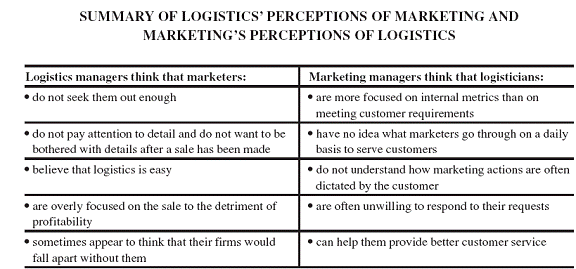
To the surprise of no one with experience in either area, to a large extent logisticians and marketers think the other side is less than cooperative and focused correctly. A summary of the perspectives of each side is included by the authors, and published below:


Source: Journal Of Business Logistics, Vol. 27 - No. 2


Again, it will not come as a surprise that the authors found that “Logistics managers in our sample were frustrated by the relative indifference towards the logistics function and lack of attention to detail of their marketing colleagues. Logistician respondents stated that they frequently find themselves having to react to fulfill marketers’ promises to customers that have been made without input from logistics.”


They quote one respondent as saying, “Marketing people, in my opinion, will not come to logistics people. As a logistics person, the burden of proof is on me to go to them.”


On the other hand, as the authors write, “A common perception among the marketing manager respondents was that logistics is often willing to forsake the customer to save on costs.”


One interviewee on the marketing side commented: “You always get the feeling when you talk to [logistics] people that they’re too busy.” Does that ring home at all?


The authors identified a number of barriers to improved collaboration between sales and marketing. These are summarized below:


Source: Journal Of Business Logistics, Vol. 27 - No. 2


The approaches to overcoming these barriers should be fairly obvious. In the end, it’s all about leadership, communication, and listening first, talking second.


Certainly, many consumer goods companies, such as Campbell’s Soup and a number of others, that have very successfully implemented customer logistics teams that integrate sales, marketing and logistics, understand these opportunities very well.


What’s your take on the integration of marketing and logistics? Is it better than in the past? Why or why not? How do you think it the collaboration can best be improved?

Wednesday, January 24, 2007

DHL包揽Wyeth药业物流业务合同

DHL bags Wyeth logistics contract

24/01/2007 - Shipping giant DHL has bagged a lucrative contract with pharma giant Wyeth and become the first logistics provider to be given complete responsibility for a company’s worldwide clinical trial materials distribution.

It is no surprise that Wyeth is the first pharma company to make such a move. The company is a huge proponent of outsourcing in order to stay competitive and its business model is now based around the principle of outsourcing or off-shoring anything that is not a core function.

According to DHL, Wyeth is hoping the new arrangement will increase efficiencies within its clinical trial materials distribution process by “uniting the flow of information and physical goods through automation and improved collaboration.”

It will also enable each step of medical material transfer to be visible and monitored from product development to trial to consumption, providing Wyeth with improved visibility and control of its clinical shipments, said DHL.

Under the deal, the terms and length of which were not disclosed, DHL will oversee and co-ordinate the logistics of Wyeth's clinical material shipments and processes throughout multiple distribution channels across the globe, as well as the warehousing of materials.

Together, Wyeth and DHL will create a closed-loop clinical trial materials supply chain to streamline track and trace capabilities, financial and performance indicators and operational process flows.

Commenting on the arrangement, Ira Spector, vice chief of operations in clinical development at Wyeth Research said: "We believe this unique collaboration has the potential to reduce the logistical complexity of our clinical trial operations by providing a leading global infrastructure, and expertise in logistics solutions within the life science industry."

"Our goal is for DHL to significantly streamline our clinical trials logistics operations, improve our clinical trial logistical analysis and rationalisation of related warehouse optimisation, and encompass services provided to our research organisation and third party service providers."

Tuesday, January 23, 2007

什么是射频识别?


射频识别即RFID(Radio Frequency IDentification)技术,又称电子标签、无线射频识别,是一种通信技术,可通过无线电讯号识别特定目标并读写相关数据,而无需识别系统与特定目标之间建立机械或光学接触。
Radio Frequency Identification (RFID) is an automatic identification method, relying on storing and remotely retrieving data using devices called RFID tags or transponders. An RFID tag is an object that can be attached to or incorporated into a product, animal, or person for the purpose of identification using radio waves. Chip-based RFID tags contain silicon chips and antennae. Passive tags require no internal power source, whereas active tags require a power source.

RFID标签的类别
Types of RFID tags
RFID标签分为被动,半主动(也称作半被动),主动三类。
RFID cards are also known as "proximity", "proxy" or "contactless cards" and come in three general varieties: passive, semi-passive (also known as semi-active), or active.
被动式(Passive)

被动式标签没有内部供电电源。其内部集成电路通过接收到的电磁波进行驱动,这些电磁波是由RFID阅读器发出的。当标签接收到足够的信号时,可以向阅读器发出数据。这些数据不仅包括ID号(全球唯一标示ID),还可以包括预先存在于标签内EEPROM中的数据。

由于被动式标签具有价格低廉,无需电源的优点。目前市场的RFID标签主要是被动式的.

半主动式(Semi-Active)

一般而言,被动式标签的天线有两个任务,第一:接收阅读器所发出的电磁波,藉以驱动标签IC;第二:标签回传信号时,需要靠天线的阻抗作切换,才能产生0与1的变化。问题是,想要有最好的回传效率的话,天线阻抗必须设计在“开路与短路”,这样又会使信号完全反射,无法被标签IC接收,半主动式标签就是为了解决这样的问题。半主动式类似于被动式,不过它多了一个小型电池,电力恰好可以驱动标签IC,使得IC处于工作的状态。这样的好处在于,天线可以不用管接收电磁波的任务,充分作为回传信号之用。比起被动式,半主动式有更快的反应速度,更好的效率。

主动式(Active)

射频识别技术包括了一整套信息技术基础设施,包括:

* 射频识别标签,又称射频标签、电子标签,主要由存有识别代码的大规模集成线路芯片和收发天线构成,目前主要为无源式,使用时的电能取自天线接收到的无线电波能量;
* 射频识别读写设备以及
* 与相应的信息服务系统,如进存销系统的联网等。

将射频类别技术与条码(Barcode)技术相互比较,射频类别拥有许多优点,如:

* 可容纳较多容量。
* 通讯距离长。
* 难以复制。
* 对环境变化有较高的忍受能力。
* 可同时读取多个标签。

相对地有缺点,就是建置成本较高。不过目前透过该技术的大量使用,生产成本就可大幅降低。
技术及性能参数
射频识别标签是目前射频识别技术的关键。射频识别标签可存储一定容量的信息并具一定的信息处理功能,读写设备可通过无线电讯号以一定的数据传输率与标签交换信息,作用距离可根据采用的技术从若干厘米到1千米不等。

识别标签的外形尺寸主要由天线决定,而天线又取决于工作频率和对作用距离的要求。目前有四种频率的标签在使用中比较常见。他们是按照他们的无线电频率划分:低频标签(125或134.2千赫),高频标签(13.56兆赫),超高频标签(868到956兆赫)以及微波标签(2.45GHz)。由于目前尚未制定出针对超高频标签使用的全球规范,所以此类标签还不能够在全球统一使用。而超高频标签的应用目前也最受人们的最受注意,此类标签主要应用在物流领域。频率越高,作用距离就越大,数据传输率也就越高,识别标签的外形尺寸就可以做得更小,但成本也就越高。目前面向消费者的识别标签外形尺寸需求,一般以信用卡或商品条形码为准。

2005年初每标签的价格仍在30欧分左右,大批量(十亿个以上)生产的射频识别标签的价格可望在2008年降至10欧分以下。

鉴于标签和读写设备之间无需建立机械或光学接触,密码技术在整个射频识别技术领域中的地位必将日益提高。随着射频识别的普及,不同厂家的标签和读写设备之间的兼容性也将成为值得关注的问题。

此外,使用寿命、使用环境和可靠性也是重要参数。
Current uses:
Passports,
Transport payments,
Product Tracking,
Automotive,
Animal identification,
RFID in inventory systems,
RFID mandates,
Human implants.

Security concerns
A primary security concern surrounding RFID technology is the illicit tracking of RFID tags. Tags which are world-readable pose a risk to both personal location privacy and corporate/military security. Such concerns have been raised with respect to the United States Department of Defense's recent adoption of RFID tags for supply chain management. More generally, privacy organizations have expressed concerns in the context of ongoing efforts to embed electronic product code (EPC) RFID tags in consumer products.

A second class of defense uses cryptography to prevent tag cloning. Some tags use a form of "rolling code" scheme, wherein the tag identifier information changes after each scan, thus reducing the usefulness of observed responses. More sophisticated devices engage in challenge-response protocols where the tag interacts with the reader. In these protocols, secret tag information is never sent over the insecure communication channel between tag and reader. Rather, the reader issues a challenge to the tag, which responds with a result computed using a cryptographic circuit keyed with some secret value. Such protocols may be based on symmetric or public key cryptography. Cryptographically-enabled tags typically have dramatically higher cost and power requirements than simpler equivalents, and as a result, deployment of these tags is much more limited. This cost/power limitation has led some manufacturers to implement cryptographic tags using substantially weakened, or proprietary encryption schemes, which do not necessarily resist sophisticated attack. For example, the Exxon-Mobil Speedpass uses a cryptographically-enabled tag manufactured by Texas Instruments, called the Digital Signature Transponder (DST), which incorporates a weak, proprietary encryption scheme to perform a challenge-response protocol.

Still other cryptographic protocols attempt to achieve privacy against unauthorized readers, though these protocols are largely in the research stage. One major challenge in securing RFID tags is a shortage of computational resources within the tag. Standard cryptographic techniques require more resources than are available in most low cost RFID devices. RSA Security has patented a prototype device that locally jams RFID signals by interrupting a standard collision avoidance protocol, allowing the user to prevent identification if desired. Various policy measures have also been proposed, such as marking RFID tagged objects with an industry standard label.

Controversy.
How would you like it if, for instance, one day you realized your underwear was reporting on your whereabouts?

— California State Senator Debra Bowen, at a 2003 hearing

The use of RFID technology has engendered considerable controversy and even product boycotts by consumer privacy advocates such as Katherine Albrecht and Liz McIntyre of CASPIAN who refer to RFID tags as "spychips". The four main privacy concerns regarding RFID are:

* The purchaser of an item will not necessarily be aware of the presence of the tag or be able to remove it
* The tag can be read at a distance without the knowledge of the individual
* If a tagged item is paid for by credit card or in conjunction with use of a loyalty card, then it would be possible to tie the unique ID of that item to the identity of the purchaser
* The EPCglobal system of tags create globally unique serial numbers for all products.

Most concerns revolve around the fact that RFID tags affixed to products remain functional even after the products have been purchased and taken home and thus can be used for surveillance and other purposes unrelated to their supply chain inventory functions. [citation needed]

Another privacy issue is due to RFID's support for a singulation (anti-collision) protocol. This is the means by which a reader enumerates all the tags responding to it without them mutually interfering. The structure of some collision-resolution (Medium Access Control) protocols is such that all but the last bit of each tag's serial number can be deduced by passively eavesdropping on just the reader's part of the protocol. Because of this, whenever the relevant types of RFID tags are near to readers, the distance at which a tag's signal can be eavesdropped is irrelevant; what counts is the distance at which the much more powerful reader can be received. Just how far this can be depends on the type of the reader, but in the extreme case some readers have a maximum power output of 4 W, enabling signals to be received from tens of kilometres away.[citation needed] However, more recent UHF tags employing the EPCglobal Gen 2 (ISO 18000-6C) protocol, which is a slotted-Aloha scheme in which the reader never transmits the tag identifying information, are not subject to this particular attack.

RFID Shielding(射频识别屏蔽)

A number of products are available on the market in the US that will allow a concerned carrier of RFID-enabled cards or passports to shield their data. Simply wrapping an RFID card in aluminum foil, essentially creating a Faraday cage, is claimed to make transmission more difficult, yet not be completely effective at preventing it.

Shielding is again a function of the frequency being used. Low-frequency tags, like those used in implantable devices for humans and pets, are relatively resistant to shielding, though thick metal foil will prevent most reads. High frequency tags (13.56 MHz -- smart cards and access badges) are more sensitive to shielding and are difficult to read when within a few centimetres of a metal surface. UHF tags (pallets and cartons) are very difficult to read when placed within a few millimetres of a metal surface, although their read range is actually increased when they are spaced 2-4 cm from a metal due to positive reinforcement of the reflected wave and the incident wave at the tag. UHF tags can be successfully shielded from most reads by being placed within an anti-static plastic bag.

物流追踪方案:DHL将在美国全境部署最新一代无线局域网络系统

Logistics Tracking Solution: DHL To Employ Latest Generation Wi-Fi Systems Throughout U.S. Network
1/22/2007

DHL New Handheld Scanners to Enhance Shipment Visibility for DHL Customers

DHL, the world�s leading express delivery and logistics company, announced it is adopting the latest �new generation� scanning technology, deploying a single system across the entire DHL US network to provide enhanced shipment visibility for DHL customers. The new scanning devices, used to capture shipment information by couriers and other operations personnel and utilizing a Wi-Fi (wireless local area network connectivity) communications system, will be deployed nationwide by third quarter 2007.

The �new generation� technology will provide immediate visibility and real-time tracking for customers, and increase the speed in which personnel can process shipments at both customer locations and DHL facilities, providing timely, accurate, and up-to-the-minute status of packages.

�The adoption of this new technology will allow us to provide enhanced service, and yield greater efficiencies,� said Jose Eiras, Chief Information Officer for DHL Express USA. �Leveraging the latest technology platforms to best-serve our customers is a key element in delivering a superior customer experience.�

Unlike many systems used throughout the transportation industry, the DHL wireless scanners leverage the latest GPRS (General Packet Radio Service) and WLAN (Wireless Local Area Network) technologies, which will enable DHL to transmit customer shipment information automatically � from pickup to final delivery � without the need to wait and place a device within a transmission cradle. The information will be immediately fed into DHL back-end systems, providing instant visibility to customers looking for shipment status through calls to customer service, the DHL web site, or DHL shipping systems.

The new handheld (Motorola HC 700) system will provide the same functionality as current DHL scanning devices -- such as electronic signature capture, barcode scanning, and instant communication links to dispatchers � but has expandable memory to allow for future applications such as image-capturing to ensure DHL continues to be responsive to customer needs.

In addition, the new DHL scanning technology is RFID-ready (Radio Frequency Identification), affording DHL the ability to integrate the new technology with future RFID products already in development. DHL is committed to bringing the benefits of RFID to the U.S. market and worldwide, and has taken a leadership position to support further development and international standardization of RFID technology. RFID is used to read and store data without the need for contact or direct line of sight and promises improvements in supply chain management for industries worldwide.

DHL will be integrating its Microsoft Windows-based courier application within the Motorola HC 700 device. Over 20,000 of the new scanners will be placed into operation throughout the DHL US network over the next 9 months.

DHL Express International Americas also announced the implementation of the wireless technology to be used throughout Canada, the Caribbean and Latin America, with plans for completion by the second quarter of 2007.

About DHL
At DHL, Customer Service is back in shipping. Our mission is to provide the most flexible, personable and enjoyable experience in the shipping industry for our customers. DHL is the global market leader of the international express and logistics industry, specializing in providing innovative and customized solutions from a single source. DHL offers expertise in express, air and ocean freight, overland transport, and contract logistic solutions as well as international mail services, combined with worldwide coverage and an in-depth understanding of local markets. DHL's international network links more than 220 countries and territories worldwide with over 285,000 employees dedicated to providing fast and reliable services that exceed customers' expectations. www.dhl.com

Kerry Logistics and TALKE物流服务签署协议进军中国化学物流业

Kerry Logistics And ALFRED TALKE Logistic Services Sign Deal To Enter Chemical Logistics Sector In China
1/23/2007

Hong Kong - Kerry Logistics and TALKE Logistic Services have signed a joint venture agreement to provide a full range of specialist chemical logistics services throughout mainland China.

The deal will see Kerry Logistics expertise and network in the China market combine with TALKEs specialist chemical industry knowledge to deliver world class logistics services.

“We are convinced Kerry-TALKE will provide a powerful combination of local experience and specialist chemical logistics know how for the benefit of our clients in this fast developing market, said Vincent Wong, Joint Managing Director, Kerry Logistics.

Kerry Logistics in China provides a range of logistics services including freight forwarding, express parcel delivery, contract logistics, warehousing and distribution. The company offers Pan China solutions to customers in 1,100 cities with 4,000 staff in 120 offices.

TALKE Logistic Services, headquartered near Cologne in Germany, is one of the leading chemical logistics service providers in Europe. The TALKE group employs 1,600 people in 23 locations across Europe, the Gulf States and China and has been providing logistics services to major global chemical production manufactures for the last 60 years.

Joining forces with Kerry Logistics in China gives us an ideal platform to further implement our strategy of international development with strong local partners, said Richard Heath, Chief Business Development Officer of TALKE Logistic Services.

SOURCE: Kerry Logistics and TALKE Logistic Services

人尽其才,物畅其通。

在德国学习物流将近一年,对物流渐渐有了些感觉,从今天开始记录些自己的感受和在学习过程中收集的一些信息。